Assessing User Demographics and Interest Data
Mining Demographic and Interest Data to Sharpen Search Intent
Demographic and interest overlays in Google Analytics are rarely the first place an SEO looks, but they deserve a closer interrogation. These reports are not vanity metrics. They act as a secondary search log, revealing why a user was in a buying or learning state when they arrived and whether your content actually serves that state.
The distinction between affinity and in-market segments is where the real signal lives. Affinity categories reflect sustained interests, the kind of person who follows industry thought leaders. In-market segments approximate active shopping behavior. That difference maps directly to search intent. A page optimized for “project management tools” might rank for broad informational queries, but if the organic traffic to that page is heavily clustered in the in-market segment for “Project Management Software,“ you are attracting users much closer to a purchase decision than expected. If that page does not address pricing, implementation, or vendor comparison, it will leak conversions to competitors.
You can operationalize this by building a segment for organic traffic constrained to a relevant in-market category. Then pull the landing page report and rank pages by engagement rate or engagement time, not sessions. A high-traffic page with strong in-market share but poor engagement signals that the title promise and body copy are not aligned with a transactional mindset. That is an SEO opportunity no rank-tracking tool can reveal.
Affinity segments work in the complementary direction. If you are expanding into a new topic cluster, affinity data tells you which interests your cumulative audience already shares. Suppose your analytics show heavy organic concentration in “Business Software” and “Small Business Owners.“ Instead of guessing at topics, mine the affinity overlap. Those users are likely to click your brand queries and newsletter signups. Their profile provides a lightweight taxonomy of content ideas, from operational efficiency to sales automation.
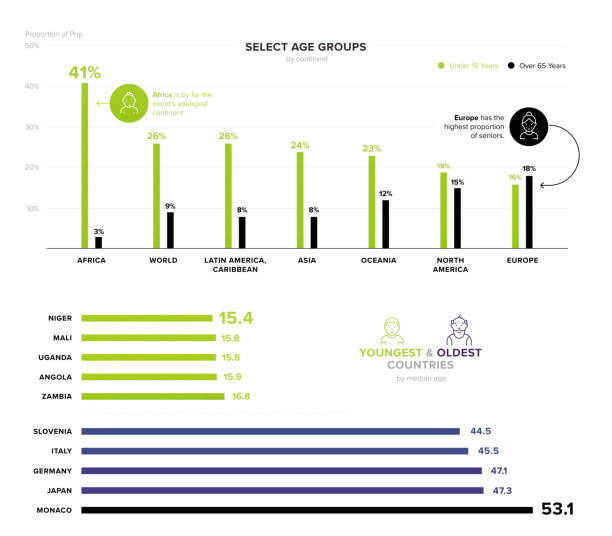
Another layer to exploit is the age-by-interest matrix. Cross-tabulation lets you see whether a high-intent in-market segment skews younger or older. That can influence structured data choices, internal linking, and the example scenarios used in a page. For instance, an in-market segment for accounting software may skew older and align with queries like “small business accounting solution,“ while an interest-based segment for financial news skews younger. The same topic can be split into two distinct content assets with separate title-tag angles.
The real payoff comes when you combine demographics with behavior. Age and gender data in GA4, especially with Google Signals and modeled data, is noisy and probabilistic. But it is useful as a strategic constraint. If organic sessions in the 45–54 age band engage well but convert poorly, the content’s language, authority level, or decision stage may be off. The keywords are the same, but the searcher’s mental model differs. Instead of rewriting for a generic user, test more experienced, decision-maker-oriented copy. Conversely, if the 18–24 segment shows strong engagement but low intent, the page attracts researchers, which is fine for brand awareness but not for ranking a “best” or “top” page.
Another practical move is to compare demographic segments against internal site search. Filter the GA site search report by an age range or in-market category and look at what those users search after landing. If your organic landing page is “SEO tools” and users in the in-market “Advertising Services” segment immediately search for “enterprise plans,“ you have found a missing page. That is latent demand expressed inside your own logs, and it is directly actionable.
Do not treat demographics as deterministic. Consent changes, cookie deprecation, and privacy-driven modeling mean the numbers are not an exact census. But aggregate direction over several weeks is enough to test an audience hypothesis. The key is to use them as a filter, not a chart. Segment organic traffic by affinity or in-market category, cross-reference with engagement and site search, then let observed behavior drive content briefs. You are not asking GA to identify every visitor; you are asking it to highlight structural differences in intent that keyword-level reporting misses.
The future of SEO is not just ranking for a query but matching the user’s internal state at the moment of search. Google Analytics demographics and interest data are one of the only free, accessible proxies for that state. Ignore them and you fly blind. Use them as a layer on top of search performance, and you gain a sharp edge.